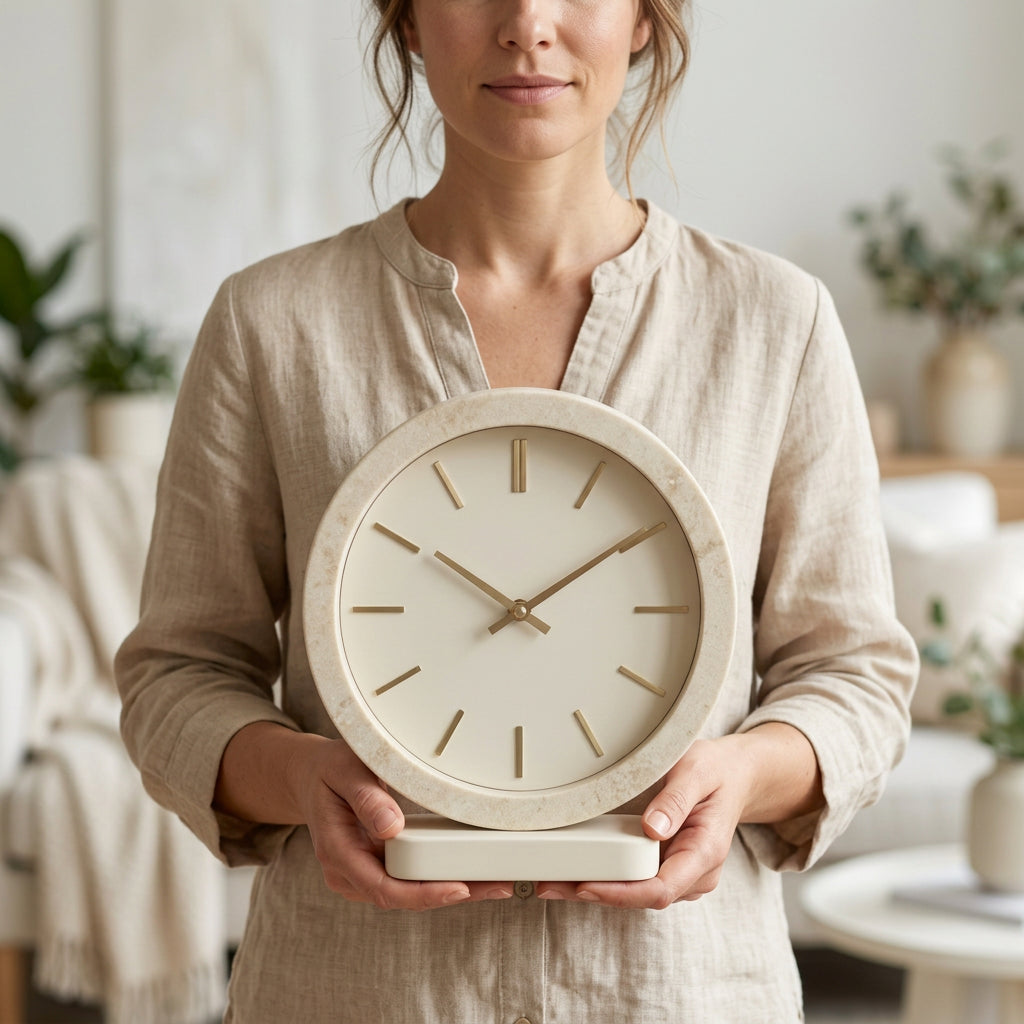
Round Table Clock — Warm Ivory-Toned Frame, Gold-Tone Baton Markers & Rectangular Pedestal for Elegant Desks and Living Spaces
Round Table Clock — Warm Ivory-Toned Frame, Gold-Tone Baton Markers & Rectangular Pedestal for Elegant Desks and Living Spaces
Couldn't load pickup availability
THE TABLE CLOCK / A DAY IN THREE SCENES
🕰️ Make Time Part of the Room, Not Just the Routine.
The useful things in a home can be the beautiful things, too. The table clock pairs a round analog clock face with a substantial-looking ivory-toned surround and a simple rectangular pedestal. Gold-tone hands and slender baton markers introduce definition without filling the dial with numerals or elaborate decoration.
The result is a tabletop design with an architectural outline: a circle above a low rectangle, a pale face within a deeper rim, and a few warm accents arranged around a clear center. It has enough character to be part of a considered display while keeping the overall appearance restrained.
For mornings with a little more intention, afternoons in a familiar chair, and the everyday places where design and routine meet.

🌅 Scene One: The Morning Before the Day Gets Busy
The notebook is open, the room is familiar, and the first few decisions of the day are still ahead. Imagine the table clock on a secure corner of your desk, its circular face offering a visual contrast to the rectangular objects around it. There is no complicated decorative scene to arrange: the strong outline already gives the piece a clear presence.
The pale palette is particularly easy to imagine beside cream stationery, light wood tones, and understated desk accessories. A darker notebook or a muted green pencil holder can introduce enough contrast to keep the setting from feeling too uniform. Leave the dial unobstructed, and choose a position that suits your usual viewing angle.
This is not about making every morning look like a photograph. It is about choosing an everyday object whose appearance feels at home among the things you actually use.
Between the Moments: A Face Edited Back to Essentials
The table clock's photographed dial uses slender gold-tone markers rather than printed hour numerals. Their repeated linear shape creates a steady rhythm around the circular face, while a paired marker at the top gives the arrangement a small point of distinction. The open space between the markers keeps the composition visually spare.
The hands continue the same warm-toned direction, meeting at a small central fitting. Their angular lines contrast with the curved frame, adding structure to the softer palette. The photographs also show a finer hand crossing the face, though they do not establish its movement type or operating behavior.
What stands out is the relationship between the details rather than any one decorative flourish. The markers, hands, and center share a consistent visual language, while the lighter dial gives them room to remain distinct.

A circle gives the design its softness. A few clear lines give it definition.
📔 Scene Two: An Afternoon with Familiar Things
A book left within reach. A low vase on the cabinet. The comfortable place you return to when there is time to sit for a while. In a living-room arrangement, the table clock can become part of that familiar view rather than an object that feels separate from the décor.
The lifestyle photograph shows the clock on a wood-toned cabinet beside stacked books and a simple vase. The round face supplies the tallest outline in the immediate grouping, while the books create lower horizontal layers. The arrangement stays readable because each element has a different shape and enough room around it.
Borrow that relationship rather than copying every accessory. Pair a round object with something lower and more angular. Give the pale frame a backdrop that lets its outline remain visible. Keep practical items where they can be reached without disturbing the clock, and allow the base to sit fully supported on the surface.

The Frame: More Than a Border
The circular surround gives the clock a more sculptural appearance than a thin outline alone would provide. Its visible depth creates a defined side profile, while the lighter dial appears set within the rim. This layering makes the face feel contained without introducing a separate contrasting color.
Subtle tonal variation and a textured-looking surface are visible across the ivory-toned frame in the photographs. These details give the pale surround visual interest without a strong pattern. The rectangular base repeats the light palette but changes the geometry, grounding the circular body with a lower horizontal form.
That simple combination can relate to several interior directions. In a warm neutral room, the clock can feel tonal and understated. Against deeper wood or muted charcoal, the pale shape becomes more prominent. With a small gold-tone accent nearby, the hands and markers can connect to the wider arrangement without needing a perfectly matched set.
🫒 A Palette for the Spaces You Already Love
Warm ivory connects visually with oatmeal fabrics, pale walls, and cream accessories.
Gold-tone details introduce a restrained warm accent rather than an all-over metallic appearance.
Wood tones provide a richer backdrop, helping the circular silhouette remain distinct.
Muted olive or gray can be used nearby for a softer contrast than a bright accent color.
🌇 Scene Three: Coming Home to a Considered Corner
At the end of the day, the room does not need to put on a performance. It simply needs to feel like yours. The table clock's restrained outline suits an arrangement that stays welcoming rather than elaborate: a clear section of console, a favorite object nearby, and a backdrop that gives the clock enough visual separation.
On an entry console, place it outside the area used for keys, bags, or frequently moved items. On a sideboard, give the dial a clear line of sight from where you normally enter or sit. On open shelving, check that the full clock and base fit comfortably, with adequate clearance above and around the frame.
The best position is not necessarily the center of the room. It is the place where the object feels useful to the way you live and visually connected to its surroundings.
🎞️ The Everyday Detail That Stays in View
Some home purchases are chosen for a single occasion. Others become part of the setting you return to every day. A clock belongs to that second category: something you may glance at briefly, then notice differently when you settle into the room.
The table clock brings that familiar object into a more decorative context through its circular surround, warm-toned details, and simple pedestal. You do not need to build an entire room around it. A few considered relationships, pale beside warm, round beside rectangular, detailed beside plain, can be enough to make it feel deliberately placed.
Before You Set It in Place
- Confirm the dimensions. Check total height, face diameter, overall depth, and base footprint. Room photographs illustrate styling rather than exact scale.
- Check operating requirements. Refer to the confirmed specifications for movement type, power source, battery size, and whether batteries are included.
- Do not assume extra features. The images do not establish silent operation, sweep movement, alarm, illumination, or any particular accuracy rating.
- Verify the materials. The ivory-toned appearance does not confirm marble, stone, ceramic, resin, weight, or a handmade finish. Gold-tone details do not establish precious-metal content.
- Choose a stable surface. Keep the base fully supported away from edges, moisture, heat sources, and busy areas where the clock could be knocked.
- Follow supplied instructions. Use the manufacturer's guidance for setting the time, installing the correct power source, handling, and cleaning.
Colors and surface appearance can vary with lighting and screen settings. Furniture, books, and vases in the photographs are styling references, not assumed package contents.
Give the Everyday Hours a Thoughtful Setting.
A pale circular frame. A few warm lines around an open dial. A simple pedestal beneath. The table clock brings these elements together in a tabletop clock whose appearance feels considered without being complicated.
Choose the table clock and make a familiar daily object part of a room you enjoy looking at.